Do You Actually Own What You Create?


The underlying principle for intellectual property laws around the globe is heavily based on the labor theory wherein a person is entitled to the fruits of his labor. Hence, the intellectual property law aims to achieve exclusivity to the creator of any particular work thereby providing him rights to exploit his work, while at the same time safeguarding him from any third person attempting to infringe his work. Historically, the framework in copyright law gained pace post the advent of the Industrial Revolution more particularly after the invention of the printing press. However, it is certainly not the case that means of fixation did not exist before the invention of the printing press. It is indeed true that a lot many writers, poets, teachers, and even common people used paper to inscribe their writings.
One such intellectual property right that is exclusive to a particular class of works is copyright. The majority of these works with copyright protection are computer programs, sound recordings, motion pictures, and literary, dramatic, and artistic works. These pieces are frequently credited to the author of the original work. The idea that a work's author is its first owner is a cornerstone of copyright law. Nonetheless, the copyright may be assigned in order to transfer such ownership. Furthermore, it is important to remember that such rights can also be transferred through licensing agreements rather than only through ownership.
- Definition and purpose of Copyright:
The copyright law primarily aims towards encouraging creativity and innovation on one hand and protecting the intellectual property rights of the creators on the other. As iterated earlier, this is done by granting them exclusive rights to control and benefit from their creations. However, the law aims to also strike a balance between individual interests and public interests, thus promoting cultural and educational development by facilitating fair use and accessibility under certain exceptions. Moreover, the law of copyright protection against infringement by offering a speedy remedy.
The Merriam-Webster dictionary simply defines copyright to be “the exclusive legal right to reproduce, publish, sell, or distribute the matter and form of something (such as a literary, musical, or artistic work).” This intellectual property has multifaceted connotations when it comes to the labyrinth of legal frameworks. The Berne Convention of 1886 for the protection of literary and artistic works was perhaps the first international deliberation to secure exclusive rights of authors of specific works. This approach was subsequently strengthened and accordingly, numerous instruments on the international level were articulated to secure such rights. For instance, the Universal Copyright Convention of 1952, the Rome Convention of 1961, the Trade Related aspects of Intellectual Properties (TRIPS) agreement of 1994 and even the WIPO Copyright Treaty, of 2002 aimed to enhance the protection granted under the law of copyright and thus ensuring universal protection through national deliberations.
Intrinsically copyright entails a negative right in itself as it grants protection to the author of a particular work from copies being made by anyone else without his consent or permission. Thus, when an author creates a work the subsequent right granted prevents others from copying the work and associating themselves with it all together. The exclusivity of this right is the foundational pillar of the subsequent privileges enjoyed by the author. These principles of copyright are imbibed in the Copyright Act of 1956 in India. Traditionally, copyright subsists in original artistic, dramatic, literary, musical, sound recordings, computer programs, and cinematographic films. Section of the 1956 act highlights this aspect and enshrines works in which copyright subsists. The act's S.14 further specifies that "copyright" grants the sole authority to manage a variety of activities pertaining to one's creation. This includes reproducing the work in any form, distributing it to the public, performing or showing it, adapting or translating it, and producing films or recordings based on it. These rights also apply to the sale or rental of copies of computer programs, unless the program is not the primary item rented. For artistic works, it is also necessary to represent the work in various dimensions or mediums. It includes making copies of films and sound recordings, selling or renting them, and making them available to the general public. Thus verbatim of the act inculcates the essence of copyright that has been acknowledged in the worldwide IP regime.
- Originality:
Originality is one of the fundamental prerequisites for a verb to be protected as copyright. It means that the origination of work should be from its author and should not be copied from any other work, as observed in the case of University of London Press ltd. v. University Tutorial Press Ltd.[1] Moreover, Copyright law is concerned with the expression of thought rather than the origin of ideas, and in the case of 'literary work' with the expression of thought in print or writing. The required originality relates to the expression of thought; however, the Act does not require that the expression be in an original or novel form, but that the work must not be copied from another work—that it should originate from the author. Thus, it can be observed that the concept of originality differs from that of novelty which can be seen in patent law and so it can be said that the merits of a work or, its uniqueness are not relevant. This simply implies that a work may be original even though it is relied upon or rather inspired by a previous work as long as it is in an original form.
In the case of V. Errabhadrarao v. B.N. Sarma[2], The Hon’ble Andra Pradesh High Court held that the term "original work" does not imply that it must express original or inventive thought. Copyright laws in all countries are concerned with the expression of thought rather than the origin of ideas, and in the case of literary works, with the expression of thought in writing or printing. The act does not require that expression be in an original or novel form, but that the work must not be copied from another work, and that it should originate from the author. Although, the courts have said that it is necessary that there must be a degree of originality to be present in an author's work.
The jurisprudence pertaining to the degree of originality differs territorially. The United Kingdom follows the ‘sweat of the brow’ doctrine that relies primarily on the skill and labor of the author in determining creativity in a work. This doctrine emerged from the case of Walter v Lane[3] wherein an oral speech was reproduced verbatim in a newspaper report. The question was whether such verbatim reproduction would give rise to copyright in the work which was answered in affirmative by the court. This is the same principle that was adopted in the case of the University of London Press. However, the approach of the United States differs in this aspect as the courts there have given significance to both the creative and subjective contributions of the authors. The US Supreme Court in the case of Feist Publications INC. v. Rural Telephone Service[4] completely refuted this doctrine, and it was held that in order to be original, a work must not only be the result of independent creation, but it must also exhibit some degree of creativity. Thus, the standard of creativity does not have to be high, but a certain level of creativity is required for copyright protection.
For a long time, India had strictly adhered to the ‘sweat of the brow' doctrine. However, India's 'originality' standard is not as low as England's. It was in the case of Eastern Book Company v. D.B. Modak[5], wherein, the Hon'ble Supreme Court abandoned the 'Sweat of the Brow' doctrine in favor of a 'Modicum of creativity' approach, as used in the United States, and introduced the concept of "flavor of the minimum requirement of creativity". Thus, can be seen from the above, that the notion of originality in India, which is prevalent today is a result of evolution through various interpretations. However, the cornerstone of understanding originality in the Indian context remains to be a balance of sweat of the brow doctrine and the modicum of creativity.
- Authorship & Ownership:
Intrinsically, copyright is a property right that subsists in certain specified types of ‘works’ that is derivative of an intellectual process. The law relating to intellectual property is based on certain basic principles, which, in the case of copyright is based on the concepts of originality and reproduction of the work in any material form. The Indian Copyright Act, 1957 iterates under section 13 that Copyright subsists in ‘original literary, dramatic, musical and artistic works, cinematograph films and sound recording’. One way for determining ‘original work’ is to consider the amount of skill, labor or judgment that has gone into its creation[6], the other could be ascertaining the degree of creativity, either ways, the Indian jurisprudence, mandates it to be a balance of both. Moreover, as iterated earlier, a copyright is a legal right that gives creators control over their original work, allowing them to decide how it's used and distributed.
A copyright is a form of a property right and it raises an important question about ownership and authorship. Both are two distinct concepts with their respective set of rights, hence, it could be simply understood that an author is the person who has created the work in question and the owner of the work in question may either be the author itself or it may be a third person which may be author’s employer or a person who has become owner of the copyright subsequently because the title to the copyright has been transferred to him. It is also important to know that it is the owner who has the exclusive right over a copyright, who may either be the author himself or any other person depending upon whether the copyright has been transferred. Although, it is a settled position in law under section 17 of the 1957 act that the author is the first owner unless his rights are transferred subsequently or the work is created in the course of employment, or as an independent contractor or under a contract of service or apprenticeship or given as a public speech or in case of government works.
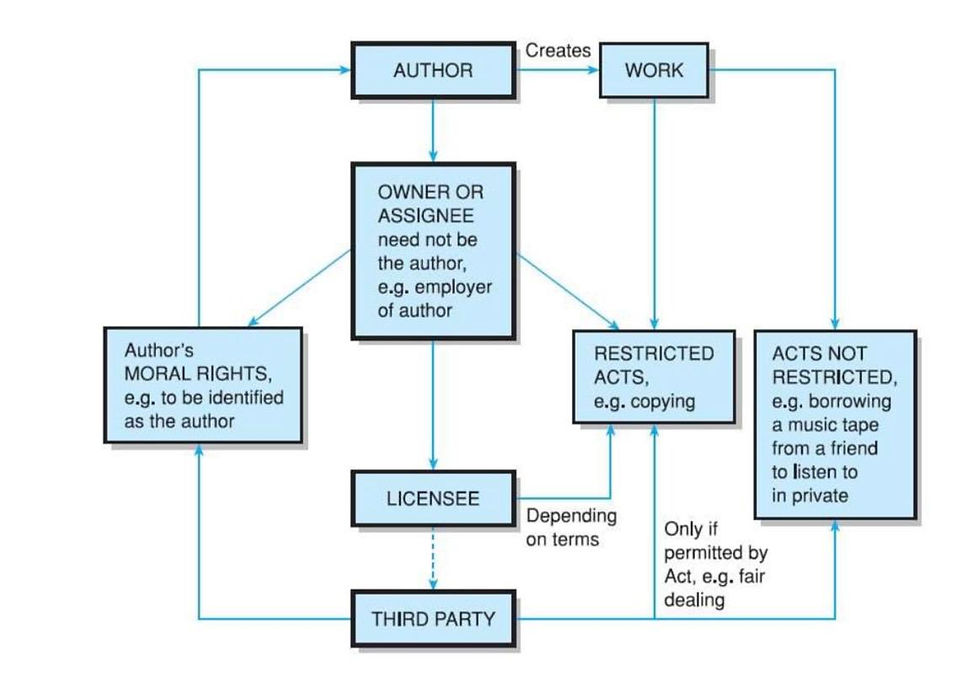
Further, S. 2(d) of the act describes who is an author in a particular class of work. For instance, when it comes to literary works, it is the creator of the work shall be considered the author whereas in the case of a work that is literary, dramatic, musical, or artistic, which is generated by a computer, that author shall be the person who causes the work to be generated. Thus, in the copyright law, only natural persons, and not incorporated entities, can be the "author". The incorporated entities may be the "owner" of a copyright.[7] Furthermore, to constitute joint authorship of a literary work, it must be the result of a predetermined joint design. Thus, making changes to a work, with or without the author's permission, does not qualify as "joint author" status[8].
- Fixation:
The term 'fixation' refers to the expression of a work in a tangible medium, implying that the work exists in some permanent form. It is worth noting that the Berne Convention is broad enough to allow member countries to decide whether or not 'fixation' is a prerequisite for copyright protection. Article 2 of Section 2 of the Berne Convention states that "it shall be a matter for legislation in the countries of the Union to prescribe that works in general or any specified categories of works shall not be protected unless they have been fixed in some material form," allowing jurisdictions to determine the requirement independently. Most countries do not require that a work be produced in a specific format in order to obtain copyright protection. For instance, fixation is not necessary in Australia, France, or Spain in order to preserve copyrights. Copyright protection for works is contingent upon the work being fixed in a tangible medium of expression, as is the case in civil law countries like the United States and Canada. The threshold may change even within the authority enforcing this rule. The United States Copyright Act, for instance, only considers the criteria satisfied when the fixation is made by the author or a person designated by the author. On the other hand, copyright law in the United Kingdom maintains that an unlawful fixation, like a covert recording, nevertheless falls under the protection of copyright, even if the person carrying out the unauthorised fixation is an offender.
In India, a work can be protected by copyright if it is original, a 'work' as defined by section 13 of the Copyright Act, 1957, and fixed in tangible form. Though the Act does not expressly state any requirements, the Copyright Manual on Registration of Artistic Works and Incidental Issues states in its foreword that "Copyright is a form of protection provided by the Indian legislature to authors/owners of original works of authorship from the time the works are created and expressed in a tangible form". The Manual, however, does not fully address the issue because it does not define the scope or limitations of the phrase 'tangible form'. This certainly paves the way for multiple ambiguous arguments, however, the objective of this dissertation limits itself from pondering much into the question of fixation. At this juncture, it is crucial to simply note that the copyright act affirms that fixation in a tangible medium is a precondition. When it comes to the subject matter of this dissertation i.e. script they are often tangible. Hence we need not deliberate much upon the concept of fixation.
- Protection:
The owner of a work under copyrights is given a bundle of rights which could be divided into moral rights and economic rights. The key difference here is that economic rights may be transferred depending upon the owner and licensing terms, however, the moral rights vest with the author. As the name implies, Economic Rights enable the owner to reap the benefits of a specific work. These rights are transferable for optimal commercial exploitation. Unlike economic rights, moral rights protect the author's personality and remain with the author even after the copyrighted work is transferred. The doctrine of moral rights has been best expressed in France, and the creator's right to preserve the form of his work from deformation by subsequent transferees has been recognized for justifying the criminal statute against plagiarism.[9]

Additionally, the protection granted under the copyright law generally lasts for the life of the owner plus another 60 years in India. It is 60 years post the death of the author in the case of original artistic, musical, literary, and dramatic works. In the case of joint authorship, the sixty-year period begins with the death of the author, who dies last. Anonymous and pseudonymous publications are protected for 60 years beginning with the calendar year following the year of publication. Furthermore, government works, public projects and international organization publications are protected for 60 years. Thus, the copyright per se grants a number of rights that extend to at least a minimum of 60 years since the creation of the work.
- Infringement:
As mentioned earlier, the fundamental idea of Copyright law is to safeguard the exclusive right of the owner of copyright from any sort of infringement upon is rights pertaining to the copyright. Infringement of copyright takes place when someone uses, reproduces, or distributes copyrighted material without permission from the owner, violating their exclusive rights. In Indian parlance, section 51 of the Copyright Act, 1957 categorizes the action of any person with the pre-requisites of infringement i.e. (a) without a license granted by the owner of the copyright, or (b) without the license granted by the registrar of copyright, or (c) in contravention of the conditions of a license so granted, or (d) any conditions imposed by a competent authority under the Act[10]. This includes actions like copying, distributing, performing, or adapting the work without authorization.
It is essential that in order for an infringement to be constituted, the work should not only be copyrightable but also there should be a substantial amount of copying. Thus, there should be substantial similarity between the work alleged as an infringing copy and the original work. In the case of R.G. Anand v. M/s. Deluxe Films[11] the court gave the following propositions that may be resorted to in order to determine substantial similarity:
i. There can be no copyright in an idea, subject matter, themes, plots or historical or legendary facts, and is confined only to form.
ii. If the same idea is developed in a different manner, similarities are bound to occur and in such cases, it needs to be determined that whether the similarities are on fundamental and substantial aspects of the mode of expression adopted in the copyright.
iii. The surest and safest test to determine violation is if the reader spectator or the viewer, after having read or seen both the works, is clearly of the opinion that one is the copy of the other.
iv. Where the theme is same, but the expressions are different, the subsequent work will be copyrightable, and there will not be any infringement in the previous work.
v. If there are similarities in the two works, along with broad dissimilarities it negates the intention to copy rendering it as merely incidental, and therefore no infringement of the copyright in the work.
vi. As infringement to copyright amounts to piracy, it should be proved with clear and cogent evidence. vii. In questions of violating copyright of a stage play by a cinematographic film, it is difficult to establish infringement by the very nature of the expression of the two works. One (film) provides a broader perspective, a wider field and a bigger background, unlike the other (theatre), which is confined and limited. Even so, if the viewer, after seeing the film, gets a totality of impression, that the film is, by and large, a copy of the original play, violation of the copyright may be said to be proved.
Hence, it can be said that the verbatim of the act provides for Primary and secondary forms of infringement. Moreover, in case of discrepancy or ambiguity one may take refuge under the established precedents set by Indian courts in order to determine similarity in an alleged infringing copy and an original work.
- Fair Use:
The notion of permitting some use of copyrighted work which is considered to be ‘fair’ is common is many jurisdictions. However, the adaptation of the term ‘fair’ in this context has taken two different forms viz. ‘fair use’ and ‘fair dealing’. The concept of fair use is relatively wider than fair dealing as to its application. It dates back to the case of Folsom v. Marsh[12], wherein the concept of ‘fair use’, was first observed, though not in verbatim, but in its essence by Justice Joseph Story. The lawsuit concerned a man named Jared Sparks, who published a twelve-volume collection of President Washington's papers with publisher Folsom, Wells, and Thurston. Sparks also had copyrights on the President's official and personal documents that he edited for The Writings of George Washington. Three hundred and fifty-three pages of President Washington's documents were copied by another writer and anthologist, Mr. Reverend Charles Upham, from the two-volume work The Life of Washington in the Form of an Autobiography, published by Marsh, Capen, and Lyon. Because Upham replicated the documents word for word from Spark's book, the plaintiffs claimed that the defendants violated their copyrights. The court while deciding in favor of the Plaintiffs also laid down a four-fold test that later evolved into the fair use doctrine applied today. Justice Story identified that while considering cases on fair use:
i. Purpose and character of the copyrighted work;
ii. Nature of the copyrighted work;
iii. Amount of Copyrighted work used;
iv. Degree in which prejudice may be caused on the original work.
Fair dealing on the other hand allows the copying or use of work which would otherwise be an infringement of copyright. However, the application of fair dealing is much narrower and specific as compared to that of fair use. The Copyright Act of 1957, entails a provision for fair dealing under section 52 as an act not constituting infringement. The protection extends to fair dealing of any work, not being a computer program, for ‘private or personal use, including research, criticism or review whether of that work or of any other work and the reporting of current events and current affairs, including the reporting of a lecture delivered in public.
The Indian courts have time and again applied the ‘fair dealing’ provision for the purpose of education. The ‘Delhi Photo Copy Case[13]’ wherein, publishers like Oxford, Cambridge, and Taylor & Francis sued a Delhi University photocopy shop for making course packs by photocopying parts of textbooks, alleging copyright infringement. However, in 2016, the Delhi High Court sided with the University and the shop. They referred to a section in the Indian Copyright Act allowing reproductions for educational purposes. The court highlighted the importance of spreading knowledge in education and ruled that copyright shouldn't obstruct this. The court also made and attempt to distinguish between fair use and fair dealings and acknowledged that both concepts are worked out in different jurisdictions worldwide. For example, the concept of fair use prevails in the U.S.A., although the U.K. and India follow the principle of fair dealing. However, the underlying principle remains the same i.e. to constitute an exception to the prevailing copyright laws for certain specific purposes that do not constitute infringement.
In conclusion, copyright law is a carefully thought-out way to protect the rights of creators while also serving the greater good. By giving authors a set of economic and moral rights, it lets them control their work and make money from it while also keeping their personal connection to it. At the same time, limitations like fair dealing make sure that access to knowledge, education, and cultural growth isn't too limited. As creative industries change in the digital age, it's important for creators, lawyers, and users to know these rights and limits.
If this piece resonated with you or you’re someone interested in collaborating on similar legal writing, feel free to reach out—my contact details are available on the home page.
[1] University of London Press ltd. v. University Tutorial Press Ltd. (1916) 2 Ch. 602
[2] V. Errabhadrarao v. B.N. Sarma, AIR 1960 AP 415
[3] Walter v. Lane, [1900] A.C. 539
[4] Feist Publications INC. v. Rural Telephone Service, 499 U.S. 340 (1991)
[5] Eastern Book Company v. D. B. Modak, AIR 2008 S.C. 809
[6] Macmillan & Co. Ltd. v. K. and J. Cooper, AIR 1924 PC 75, 85
[7] Asia Pacific Publishing Pte Ltd. v. Pioneers & Leaders (Publishers) Pte Ltd., (2011) 4 SLR 381
[8] Levy v. Rutley, (LR) 6 CP 523.
[9] Martin A. Roeder, The Doctrine of Moral Rights: A Study in the Law of Artists, Authors and Creators, 53 Harward Law Review 554, 555 (1940).
[10] John Wiley & Sons Inc. v. Prabhat Chander Kumar Jain, (2010) 170 DLT 701 (Del).
[11] R.G. Anand v. M/s. Deluxe Films, (1974) 4 SCC 118.
[12] Folsom v. Marsh, 9. F. Cas. 342 (C.C.D. Mass. 1841).
[13] The Chancellor, Masters & Scholars of the University of Oxford and Ors. v. Rameshwari Photocopy Services and Ors. 2016 SCC OnLine Del 5128.


Comments